
F1 ROC: Race Of Champions story
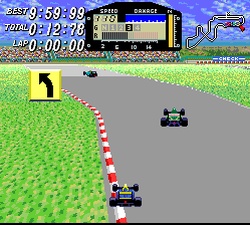
In the early ’90s we were living at two speeds: Formula One beamed live on TV, and Grand Prix glory unfolding at home on a Super Nintendo. Then came the cartridge with that bold racing stripe on the cover: F1 ROC: Race of Champions. Some shelves listed it simply as F1 ROC, friends called it “Race of Champions,” and among collectors you’d hear the Japanese title—Exhaust Heat. At video stores, folks asked for “Formula-1: Race of Champions,” and the clerks knew exactly what they meant. It quickly became shorthand for a SNES racer you could believe in: the car hisses, the circuit stretches out, corners rush at you, and your heart learns to brake a split second before your fingers do.
How speed took shape
SETA eyed the pinnacle of motorsport with the zeal of proper fans. In Japan, racing was booming, headlines were packed with world championship posters, and the dev team wanted to bottle the feeling you get flying right on the limit. They didn’t shoot for a dry sim, and they didn’t go full featherweight arcade either: they landed on that golden mean, where arcade punch arrives with a straight face. Rear-view camera, rhythm shifts, quick recces of new tracks—everything angled toward that one moment when you dive into a hairpin and think: yep, this is real-deal Formula One, only it’s happening in your living room.
Licenses were thin on the ground back then, so team and driver names got nudged around, but the world championship vibe came through instantly. On screen were familiar track silhouettes—tight city streets and flowing high-speed arcs. Magazines raved about the “amazing sense of speed” and how a 16-bit cart somehow sells the weight of braking and that twitchy surge under throttle. That early push for the “driver’s feel,” for a living connection to the racing line, became the game’s calling card.
How it went global
Japan lit up first—there it was Exhaust Heat, a title that fit like a glove: hot fumes, snap launches, elbows-out fights. In the U.S., the cart became F1 ROC: Race of Champions—a snappy name that rolls off the tongue like a summertime all-star showdown. Europe caught the wave; the game reached us by every route imaginable: rental shelves, friends’ suitcases, and market stalls with bootleg stickers. The box might sport English or Japanese lettering, but in conversation it still boiled down to the same tight nickname—F1 ROC.
SNES clubs lined TVs side by side: winners were crowned on clean laps, on keeping the car on the edge, on tidy pit stops—and on nerves of steel. Word about “that racer where the speed feels real” spread fast. Its reputation was built from retellings, from dog-eared notebooks full of scribbled passwords, from loud arguments about where to brake and whether it’s worth the gamble on those final laps.
Why it stuck
F1 ROC had a rare personality for its era: it let you live a season. It wasn’t just about laps; it was about the rhythm of the weekend—qualifying, the grid, the green-light reflex, those first meters on cold rubber, and that breathless pit-stop pause where you almost feel the crew hoisting the car by hand. It wasn’t tech for tech’s sake—it was racing drama that gave the arcade core some welcome depth. We adapted to tracks, hunted for tenths, taught ourselves to lift where we used to keep it pinned.
Another hook was the journey. You started small, no flashy contracts, proving yourself one race at a time. Upgrades, strategy calls, saving a pit stop—it all gave your wins more weight. Not a sterile spreadsheet of stats, but the everyday story of a working driver: learn the circuit—save a lap, survive the rain—save your tires, ignore the bait—hit your braking mark. No needless shackles of hyper-realism, but no cheap gimmicks either—an honest arcade racer with a heartbeat. That’s why, even years later, people recall it as “that SNES retro racer” where the third-person view and springy camera turned flat pixels into a genuine racing line.
Legacy and what came next
The success carried over the drone of the start lights: a sequel followed, and the Race of Champions name stuck right alongside Japan’s Exhaust Heat—two titles, one legend. In the Super Nintendo retro racing catalog it’s a quiet pillar: no shouting, no chest-thumping, it just fires up and hauls you through a season. Pick up the cart today and the same triggers click: the plastic smell, the TV’s flicker, the rug rustling under your feet. You immediately want to see if you still remember that fast left—and whether you can keep it tidy over the last few yards to the flag.
That’s why the different names stuck—F1 ROC, Race of Champions, “Formula-1: Race of Champions,” and, among collectors, Exhaust Heat. Each carries a shard of the same story: about arcade racers that taught us to listen to the track; about a championship we kept winning after school, late into the evening; about a car guided not just by a D-pad or a couple of buttons, but by sheer racing hunger. So when someone says “a 16-bit Formula One so honest you lose track of time,” odds are they mean this one.